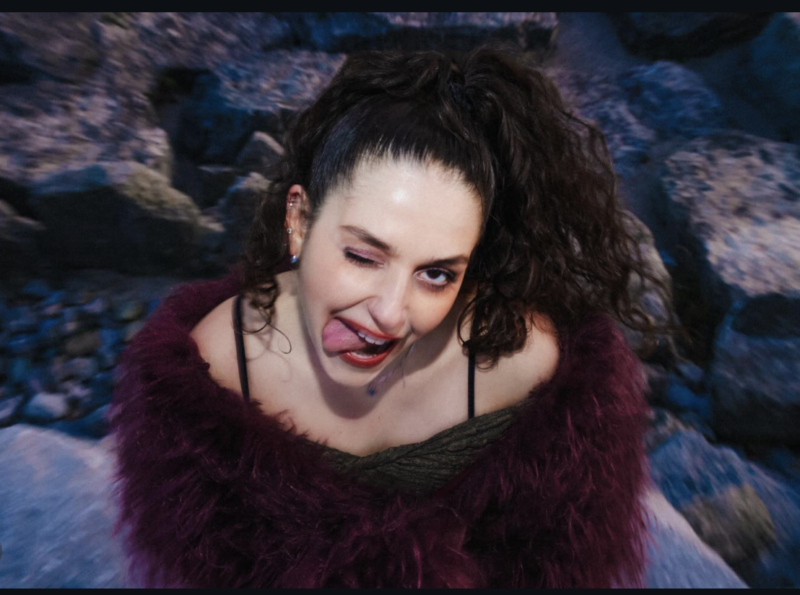
"Chameleon" feels more like an immersive world than a traditional music release. When did you realize this project needed to exist as both sound and film rather than just a song?
Right from the start, actually! It all started as a performance/visual idea before the music even existed (I'm also an actress, director, producer, and all the things, which really informed how this came together!).
I imagined the movements, the light, the frames, and the whole song grew out of that world. I wanted people to step inside it, to feel the emotions and textures, not just hear them. The visuals and the music feed off each other—they’re part of the same story.
"Chamelon" is really meant to be experienced as a space you can inhabit, not just a track you play.
You’ve described living between cultures and identities — how did your experience as a third culture individual shape the emotional core of this project?
I hope to infuse everything I do with authenticity—letting it be a true extension of who I am and a reflection of the multiple worlds I inhabit. Growing up between countries and cultures, I often felt both from everywhere and nowhere at once.
That in-between feeling became the heartbeat of this project.
Every note, frame, and movement is a way of exploring that space, carrying the sense of constant motion I’ve always known. I think we’re all multidimensional, and there’s a kind of beauty and true power in embracing all the fragments of ourselves.
The film feels incredibly intimate, with movement often communicating what words cannot. What role does the body play in your storytelling process?
I love this question so much—it’s really everything to me! On a personal level, my own journey with dissociation and sometimes feeling like a stranger in my own body has shown me just how much the body holds memory, emotion, and identity.
In the film, the body had to become its own character—a second voice that carries tension, release, and discovery. Every gesture and movement naturally became a way to tell the story.
I really believe that home starts as a physical, sensorial feeling rather than as coordinates on a map, and I wanted people to feel the story in their own bodies. The storytelling process for this piece began with raw, real emotion—that’s the place I was coming from to explore the in-between spaces of self, belonging, and transformation.
Your voice feels woven into the rhythm instead of sitting above it — how intentional was that in creating the sense of embodiment throughout the EP?
Very intentional! From the beginning, I wanted my voice to be part of the rhythm, as if it were emerging from it—blurring the lines of where one thing begins and another ends, like a messy, primal soup reflecting the world I was trying to build. I wanted the track to be felt physically, not just heard. It creates intimacy and makes the song feel alive, like it’s breathing and taking shape in real time with you.
The voice becomes another layer of movement, another way to carry the emotion. I wanted to create a full-body experience through sound.
The idea of “home” in "Chameleon" feels emotional rather than physical — has creating this project changed your own understanding of what belonging means?
This project really helped me process something I’ve always carried with me and searched for, which is my sense of home. I’ve found that home is such an elusive term—it was never a geographic place for me. Instead, it’s the feeling, the light, the places, the people you carry inside. It’s comforting to think of home as something I can inhabit emotionally, rather than geographically.
The music and film gave me a way to explore that idea, to experience and process belonging as a space you create within yourself—hopefully continuing to find and build your own anchor and north star in the midst of it all.
Transformation is central to the project — what did making "Chameleon" reveal to you about the different versions of yourself you’ve carried over time?
Making this was really healing and cathartic for me. I’ve been on a lifelong journey of confronting all the versions of myself I’ve carried over time and learning to integrate them.
Each one feels like a fragment, and while I’ve often experienced that split identity and sense of fragmentation, I’ve also always craved wholeness and stepping into an aligned, embodied power. I’ve stopped trying to compartmentalize these versions and have them compete; they can simply coexist and shape who I am.
The process was transformative and expansive. I wanted "Chameleon" to embody that evolution, to reclaim freedom and liberation from the boxes we all put ourselves in.
In the end, it really became a conversation between my past, present, and future selves—and a reminder for myself when I need it.
Connect with Gab Safa: Website