
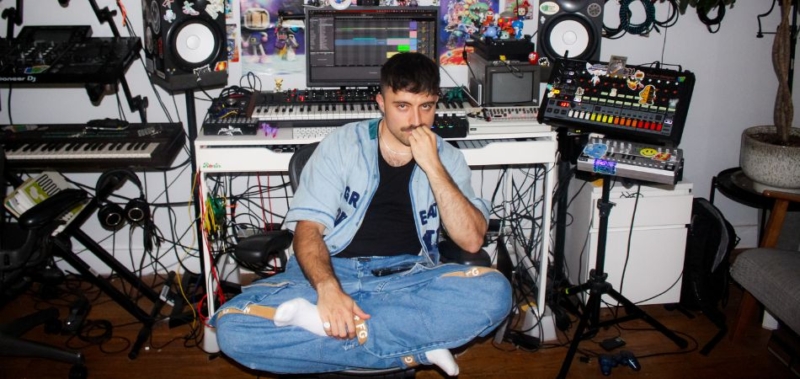
Meet Brooklyn-based DJ and producer wev, an artist steadily building momentum in NYC’s underground music scene through collaborations with Daezegxd and Yoshi T. of WHATMORE.
Now stepping into a new chapter with the release of his debut album, OST, which heavily nods to ’90s video game aesthetics, internet culture, and America’s deep-rooted house lineage, wev frames the project as a deliberate expansion of his sound.
As he puts it, “OST started with the intention to make a great electronic album, and from a desire to explore the bounds of my sonic fingerprint beyond house and club music. It ultimately became a self-portrait taken through the lens of the sounds and worlds which have shaped me.”
He explains that the title “borrows from the video game lexicon ‘original sound track’ to both honor the influence of game OSTs and composers on my work, but literally as a soundtrack to my own life experiences over the past several years.”
In speaking with wev about his journey into music and how it has led him to where he is today, wev states:
“My two central interests growing up were music and cameras. A childhood friend and I dabbled with a pirated copy of FL Studio in middle school, and in high school, I bought a DJ controller and tried to learn, but ultimately decided to focus on photography as a career. I shot mostly sports and editorial, but wound up shooting music as well—a combination of touring with DIY bands and electronic music shows.”
He continues, saying his “lightswitch” moment came while photographing Lights All Night Festival in 2015, explaining:
“During his set, the headline DJ walked across the stage and shook my hand while I was just standing there. It was unprompted and really bizarre. There was an afterparty at the house I was staying at, and the next morning, I came downstairs to find the CDJs set up and someone’s USB still plugged in. A photographer friend showed me how DJing worked, and that’s when I realized that while photographing music, I had been in the right rooms wearing the wrong shoes.”
Funny how, regardless of how winding our paths are, they place us in situations we might have been meant to be in, leading to a pivotal moment of clarity where we realize we need to correct course and go for the underlying thing that we feel most called to.
Regarding what inspires wev’s sonic palette, he describes soundtracks and video games as the impetus for his creative work, saying: “My entry point to electronic music was through the soundtrack of ‘Bomberman Hero’ for the Nintendo 64, and that, plus other video games I played as a kid, formed much of my sonic vocabulary. Today, much of my work is exploring the confluence of those soundtracks and where they intersect culturally, and stems from trying to cultivate that same inner environment of curiosity and wonder as a lens for my current life and experiences.”
Speaking on his production setup and where he prefers to work, wev says he primarily produces from his home studio or on a laptop while on tour, explaining:
“I use a lot of different hardware to build tracks, and the central ethos of my home setup is keeping the instruments hot at all times to facilitate flow state and capture ideas quickly. I typically gravitate toward hardware with its own personality. Lately, the Korg EMX1 has been a big idea starter since its PCM sounds feel close to home. The environment of my home studio is a pretty dense collection of toys and art that capture my imagination, adorning the walls. There’s a combination of things from my childhood, character designs that speak to me, friends’ art, books, and other random ephemera, which connect me to the same origin point that my desire to make music comes from. I’m quite a visual person, so the shapes, colors, and characters transmute themselves into sounds and melodies in my mind, which end up coming out in my music.”
When it comes to his typical approach to producing a track from scratch, wev states that “chasing the flow state is what excites me about making music,” as he goes on to say, “I feel connected to a larger source of creative energy outside myself. The entry point is always different. I follow impulse until a spark presents itself, and then I let the flow state guide me through capturing as much of the raw ideas and energy in the room as I can. Then I somewhat methodically arrange and iterate to a form resembling a song.”
Dissecting each layer of being an artist, from producing to collaborating with other musicians, DJing, and even recording, wev explains what each element brings him:
“As a producer, I really enjoy remixing and collaboration. They both feel like an exploration of where my musical vocabulary intersects with others’, and can be really rewarding when you find something together. When DJing I feel like a little kid, and it’s a reliable entry to flow state, which feels like an energy exchange with the room. I think my engagement with music is more about being a conduit than taking ownership of what gets made or performed, and both of these avenues are part of that experience.”
When asked whether there was a track on the album that was especially challenging to produce, and on the flip side, a personal favorite, wev explains: “‘Bad boy music’ was originally made live using the EMX and an MPC, but the MPC project file was lost, so I had to largely re-construct it from our original stem. Daze came over and chopped up some new breaks, and it brought it back to life.”
He continues, adding, “‘why do i run away?’ is probably my favorite. Of all the music I’ve made, it feels like something really true managed to come out melodically. Being vulnerable while making electronic music can be a weird, contrived process, but this felt honest.”
When asked who he would most like to collaborate with, past or present, and what he would want to create together, wev says: “Satoshi Kon — rest in peace. His direction and visual storytelling methods are so unique and mind-bending that it would be an incredibly rewarding task to represent musically. My dream is to produce an original score for an OVA or animated film someday.”
Photo-credit: Shereen Kheradyar