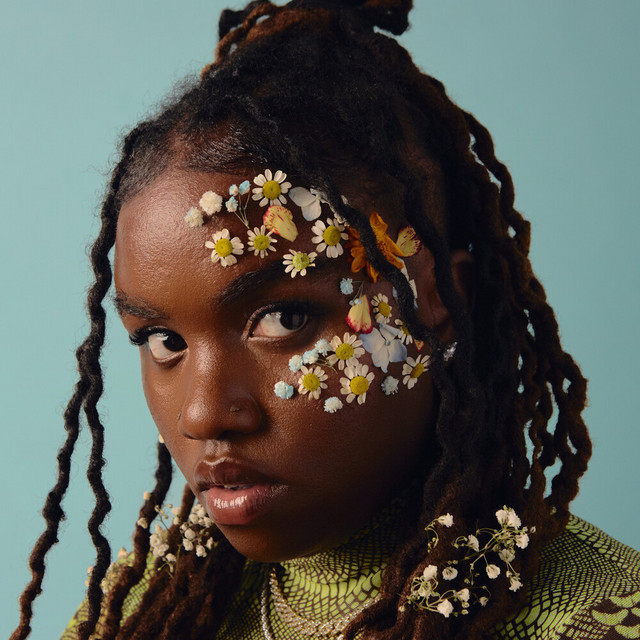
There’s something disarming about hearing Kareen Lomax sing for the first time. The tone and timbre of her voice are so distinct that, even in a chorus of 100, you’d know exactly which one is hers. Her far-reaching bass and tenor notes move through the lyrics with ease, laying claim to her unmistakable pen game. With each song, she reflects on self-worth, self-actualization, and the work of surviving grief in a way that catches listeners off guard as they find dance and hum along. But it’s enough to stop anyone in their tracks and make them really listen to how her art speaks.
Long before the Marietta, Georgia native had co-signs and collaborations with artists like Diplo, Maroon 5, and Leon Bridges, Lomax was building her own language by scribbling fragments of herself into the pages of her mother’s Bible and finding solace in writing songs that felt more honest than anything the outside world could offer. For a young woman learning how to exist in a space that didn’t always feel like home, music became a refuge where emotion could live freely, without explanation.
On ijan, her latest six-song EP and self-described “document of grief,” Lomax leans fully into the unresolved, creating songs that don’t rush toward closure but linger in the in-between. Blending alternative pop, progressive R&B, gospel, and acoustic sounds, the project moves fluidly across genres, holding tight to classic songwriting and production while pushing toward something unbound.
In conversation with EARMILK, Lomax discusses the inspiration behind the new EP, the sounds beyond R&B that shape her music, and what it means to remain unabashedly human in the age of AI.
You’ve said music was there for you in a way that religious faith or authority figures sometimes weren’t. When you think back to that younger version of yourself, what did music allow you to express that nothing else could?
I wouldn’t say I didn’t have belief growing up, but I leaned more spiritual, more searching and music was the place that met me there. Whenever I listened to something that really moved me, it felt like I was inside it, like it surrounded me, and I’d feel a kind of peace that felt honest. Music became the place where I could exist without tension, which I didn’t always have in real life. I’ve always been pretty introverted, so it became like a first language for me, how I connect with the world. A lot of what I couldn’t easily express found a home in music. In the beginning, it was survival. Over time, it became more intentional. The purpose has evolved, but that feeling of being held by it has never really changed.
Your songwriting journey began with you journaling your thoughts in the pages of your mother’s Bible before writing in notebooks of your own. How has that journaling practice shaped the way you approach songwriting today?
I think writing in my mom’s Bible felt like I was leaving something behind to be found, because I used to love finding her things. There was something sacred about it, placing pieces of myself there to be found later. It was mostly fragments, just how I felt in the moment, but that honesty has always stayed with me. I still approach songwriting in a very conversational way. Even now, there’s a part of me that writes like I’m leaving something behind, something honest enough that, if someone finds it, they’ll feel it too.
R&B is constantly evolving. With your work being a mix of alternative pop, progressive R&B, and acoustic ballads, where do you see your music fitting within the genre?
I feel like I’m more adjacent to R&B than anything, not in a way that separates me from it, but in a way that lets me move around it more freely. You can’t really listen to my music and think it’s just that. I know it’s often the first genre people think of, but I hope my music encourages a more open way of listening. A lot of what I’m drawn to comes from the classics like real musicianship, strong chords, emotion, storytelling, and I try to carry that into everything I make, while still brushing up against futurism as the sound evolves. So I see myself as part of the conversation while also expanding it, keeping those foundations intact, but pushing it into something more fluid.
When you start building a song, what usually comes first—the words, the melody, or the beat? What draws you to start there?
I actually start a lot of songs from titles. I write down every idea I have, I keep a long list in my phone, and a lot of those come from conversations or just living life. Sometimes a phrase will stick with me before anything else does, and that becomes the entry point. A song like “Somewhere in the World,” for instance, really came out of nowhere, sat with it in my phone for months, brought it up with Daoud in Brooklyn, and it became that song. I really do believe creativity is of a higher power moving through you. I’ve learned to let it.
Your latest EP, ijan, is described as a “document of grief.” When you were writing those songs, did the music feel more like a place to process those emotions, or a way to survive them? And what do you hope listeners feel when they sit with the project?
ijan is the beginning of a bigger picture, so those songs were very much me processing things in real time. I didn’t have full clarity while I was writing them; things only started to make sense after. I think that’s why it feels like a document of grief; it’s not coming from resolution, it’s coming from evolution, from being inside of it as it’s still unfolding. For me, the intention is for the listener to not feel alone. I feel like, as a whole, I’m set out to make what I needed to hear while I was grieving, something honest enough to sit with you while you’re going through it.
You’ve contributed to major hits with artists like Diplo, Maroon 5, and Leon Bridges, yet ijan feels very inward and personal. How did the songwriting process change when the stories and emotions at the center were entirely your own?
I think it was really me coming back to myself and where I started, writing for kareen lomax . Writing for others, especially at that level, is cool, but you don’t always know them. I know myself, and I can see my own vision more clearly.
A lot of your work touches on the idea of self-love, especially for people who feel like they’re still trying to figure out where they belong. Why do you think that theme has become such a central part of your storytelling as an artist?
I think a lot of that comes from being adopted and feeling like I had to explain myself at times. Whether it was people seeing me with my mom, or something as simple as my name being called on the first day of school and the teacher hesitating, it made me aware early on of not quite fitting in. That does something to you. You carry that feeling, even if you don’t always have the language for it. I don’t know if it’s as central as people might think, but I think I am my music, and that sense of searching, and hope, just naturally bleeds through.
Since the beginning of your career, listeners have discovered your music through streaming and social media. What do you hope people feel or understand about you when they press play on one of your songs?
I hope when someone presses play, it sounds like they’ve come across something imperfect and just real. I want it to feel like a place they can sit for a second, where whatever they’re carrying doesn’t feel so heavy. Even if they don’t know me, I want there to be a sense of recognition, like something in it already belonged to them. And that, no matter where you are in your timeline, it’s okay to still be figuring things out, because I am too.
Looking ahead, what kind of artistic risks or new directions are you most excited to explore in your upcoming music?
I think for me, it’s about not giving in to the idea that everything has already been done, and instead challenging that by exploring what’s unexpected. With this project, I was so focused on making it feel cohesive that I forgot I’m the actual thread between every song. That has shifted something for me. I think I’m also unsubscribing from a lot of the fear and noise around things like AI, and focusing more on what I can actually control. If anything, the real risk right now is staying as human as possible, and that’s the direction I want to keep moving in.