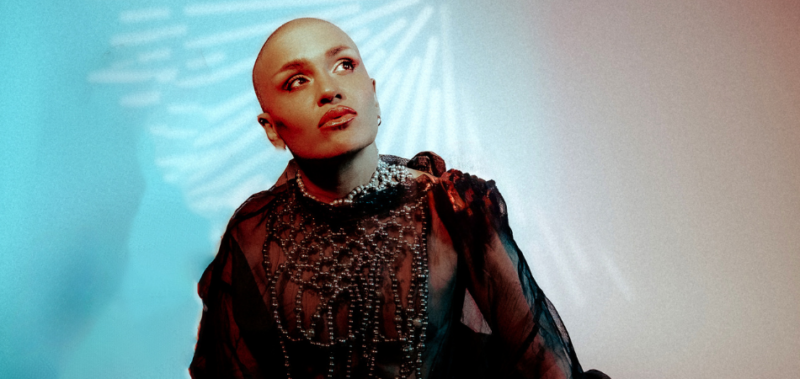
Pioneering artist ILĀ has released their new album, Quantum Computer Music.
Styled as a voice-led album that utilizes groundbreaking “quantum processes” to create musical structures, Quantum Computer Music collaborated with the UK's generative system startup, MOTH.
Trained on a dataset of ILĀ’s compositions, Quantum Computer Music features two renditions of the previously released single “UN/BOUND” – which was created for the Barbican-commissioned TRANS VOICES installation – as well as the “world’s first infinite mix”.
To go into the making of Quantum Computer Music, ILĀ took the time to answer some of EarMilk’s questions about the process.
Can you tell me a little bit about what inspired ‘Quantum Computer Music’?
Quantum Computer Music really stemmed from my fascination with the gap between what we think reality is and what’s actually happening underneath. Quantum physics describes a world that’s messy, fluid, and full of possibilities – like an ‘unreality’. That honestly feels a lot closer to my feeling in the world than the neat, predictable version we’re taught to rely on. I’m always drawn to liminal states, those moments where things feel a little unreal or slightly out of phase, and I wanted to make an album that sits in that space.
Working with quantum computing wasn’t just about the tech for me; it felt like collaborating with something that already lives in that realm. Something ‘other’ that feels unpredictable in a beautiful way, structured but dreamlike. So the inspiration was really the strangeness and possibility of it all. This idea that reality can be multiple things at once, and that music can capture a little of that shimmer.
The themes of the album are also deeply connected to the work I’ve been doing with TRANS VOICES over the past few years. “UN/BOUND”, which was co-written with Coda Nicolaeff for Feel The Sound at the Barbican, began as a holographic installation with MONOM and is now on a five-year international tour. “SECURESCUE” was another TRANS VOICES collaboration with Coda, created as a 360° performance for Sacred Sound. And “Dissociative Practices, made with Ray Felix Carter, explores dissociation not as absence but as another form of attention. That piece grew out of a residency at PRAH Studios for Movement from the Margins at Turner Contemporary, supported by People Dem Collective and Diaspora Now, and premiered at Transpose at the Barbican, which I curated this year.
How did you find working on your recent collabs with Imogen Heap, etc.?
I absolutely loved working on “Murmur” with Imogen Heap. We’ve known each other for such a long time and crossed paths creatively in so many ways. Mainly through London Contemporary Voices, the choir I co-founded with Didier Rochard for her one-off Royal Albert Hall show. But this was the first time we’d actually sat down to write and co-produce something together, just the two of us.
For the track, I built these vocal textures and patterns from an AI voice model that blended both our voices into one with Portrait XO helping me train everything. The result felt like this playful child, a third collaborator that carried both of our vocal ‘isms’ but somehow was neither of us. Everything you hear in the track comes from our voices in some form, stretched or reshaped or folded back into itself.
Hearing ourselves reflected in that way was surprisingly emotional. It felt intimate, strange, and exciting all at once – like discovering a part of ourselves we didn’t know existed until the technology held up the mirror. It made the whole collaboration feel really alive.
For those who don’t know, can you explain the ‘infinite mix’?
I’m going to give you the nerdy answer. I’ve been collaborating with MOTH for around three years now, and this was probably our most ambitious project yet. The “Infinite Mix” is a world-first that we got to premiere at Harvard. It’s a living piece of music that never repeats, never settles, and continuously generates itself in real time. Instead of releasing a track as something fixed, each listen is a unique iteration.
Everything is trained exclusively on my own music and never on scraped datasets. It was super important to me that the generative output stayed rooted in my emotional identity, but that both myself and this ‘other’ me could collaborate back and forth to make something together.
Where it gets really special is the quantum layer. The “Infinite Mix” isn’t powered by a traditional AI model. It uses a hybrid system that incorporates quantum reservoir computing, which basically means the musical decisions aren't fully deterministic. They’re shaped by quantum processes with fluctuations, interference patterns, and inherently unpredictable states. That gives the music a kind of “aliveness”: it feels organic, fluid, and responsive, even though it’s happening inside a machine.
For me it’s challenged my idea of what a “finished” record even is and asks a bigger question: What happens when music is allowed to live, evolve, and behave more like a natural system than a static artifact? I’m very excited by that.
What do you feel your identity brings to your music?
I didn’t come into music through the normal door. I studied physics and philosophy because I wanted to understand the deeper architecture of reality, only to discover that reality at the fundamental level isn’t fixed. It’s more like an unreality. Part of that impulse came from growing up totally out of sync with the world’s expectations of me. When you’re mixed race and trans, you learn early on that appearance and reality are often completely divorced – the surface tells one story while the truth isn’t some singular fixed thing.
That incongruence pushed me toward the sciences, strangely enough. I wanted to know why the world felt so rigid on the outside when my own experience was so fluid on the inside. And what I discovered in physics, especially in quantum mechanics, was something both beautiful and unsettling: uncertainty, a fundamental lack of fixity, and a reminder that nature itself refuses to collapse into binaries.
In that sense, the way I write, the way I think about sound, the way I build systems like the Infinite Mix, it all comes from this recognition that reality isn’t singular or linear. We’re taught to see the world as either/or, but quantum physics shows us a reality of both/and – multiplicity, superposition, entanglement. Everything exists in overlapping states until it’s observed.
And if the universe is allowed to be that fluid, why shouldn’t we be?
So the way quantum appears in this record is, first and foremost, as an instrument.
For me, the balance came from being very intentional about where and how I let generative technology enter the creative process. On the album, only three tracks use the generative quantum–AI hybrid systems – and even within those, the generative element is trained exclusively on [my own work]. So rather than outsourcing creativity, it became more like building a second self to collaborate with.
It’s important to say the music is still deeply human-made. The tech didn’t replace the writing, but rather extended it. It allowed me to engage with my own musical identity from a different vantage point, almost like stepping outside of myself and returning with something slightly alien but intimately familiar.
Ironically, those were the tracks that took me the longest to make. Because collaborating with a system that’s capable of endless variation means you’re constantly curating, sculpting, refining. You have to listen to the possibilities, choose your moments, and decide what emotional truth you want to anchor.
But the beauty of this technology, especially when quantum elements enter the picture, is that it enables things no human performer or producer could do alone. Take “RECURSE” – in its Infinite Mix form, it can literally run forever unless you stop it. I can’t perform that as a human being – no-one can.
How would you compare ‘Quantum Computer Music’ to your previous album?
Each of my albums marks a different stage in how I understand identity and reality. Mesonoxian was rooted in grief and liminality; “Daffodil” questioned consciousness itself, including whether AI or quantum systems might ever hold it. Back then, I was thinking about these ideas, but I didn’t yet have the tools to create with them.
With “Murmur”, I began working with hybrid AI voices, blending my voice with Imogen Heap, Bishi, Portrait XO, and Reeps One. Not to replace us, but to create timbres that couldn’t exist otherwise. I was also in the early stages of experimenting with quantum processes, but nothing generative. Everything was still composed directly with human collaborators.
Quantum Computer Music is the moment where those ideas finally become the instrument itself. Through collaborations with MOTH, Quantum Village, and my own coding, this is the first time I’ve been able to use quantum systems at the centre of the creative process, not as a concept but as a collaborator. Only three tracks use the generative quantum–AI hybrid engine, but they represent something I’ve wanted to do for years: let the music exist in a fluid, evolving state no human performer could sustain.
All of this is deeply tied to my vocal practice and my work with Trans Voices. Trans vocality is inherently about fluidity, about living between states, and resisting fixed definitions. Quantum systems mirror that beautifully: superposition, multiplicity, non-linearity. So in a way, this album finally lets my sound world match my lived experience.
Connect with ILĀ: Instagram