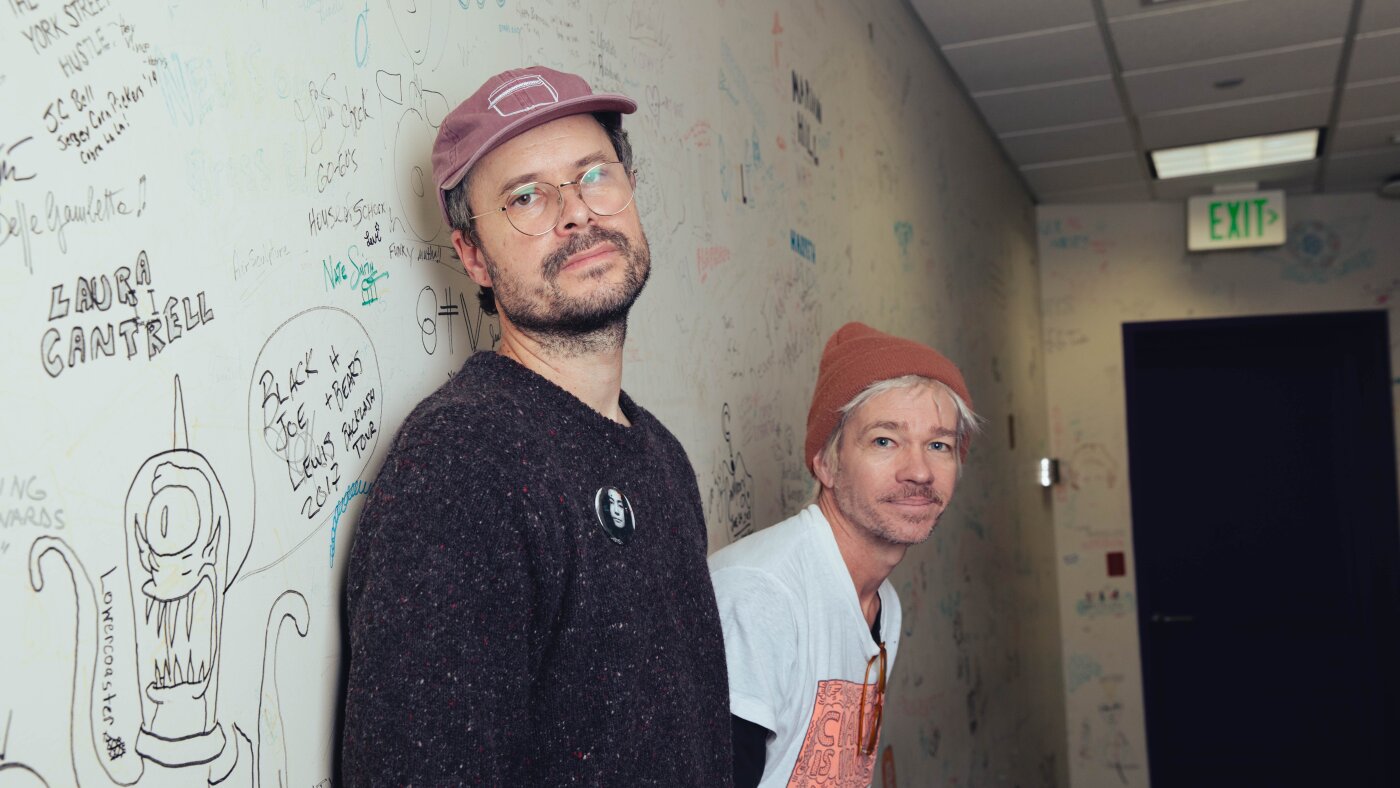


Phoenix, Arizona’s The Format released their first album in nearly two decades, Boycott Heaven, via Vanity Label on January 23, 2026.
Nate Ruess, best known as the frontman of the iconic 2010s pop triad Fun. alongside Andrew Dost and acclaimed producer Jack Antonoff, has reunited with multi-instrumentalist and longtime friend/collaborator Sam Means to release the first Format record in nearly 20 years: Boycott Heaven. Since 2006's Dog Problems, Ruess has experienced the highest peaks of musical achievement, a solo career, marriage, and fatherhood.
The combination of all of this, in tandem with time itself, has seemingly transformed the sonic landscape of a Format record. The duo has shirked the more indie/baroque elements that were common on Dog Problems for a more traditional pop/rock experience. This progression feels similar to that of Fun., whose first project, Aim and Ignite, leaned far more heavily into baroque pop than its successor Some Nights. Whether or not this change strengthens the album’s listening experience is ultimately up for debate, but it does strip away some of the Format’s DNA in a way that may leave some longtime fans nostalgic for times past.
Opening with the powerful and emotional ballad “No Gold At The Top,” the main themes of the album are immediately introduced.
“I've been handed nothing but the sense to know / Just when to go when it's time / There's no gold at the top / Only vultures waiting for you to die,” Ruess belts out over electric guitar and a steady snare combined with a thumping kick drum and subtle bass accents before the instrumental crescendos into an explosive refrain in which all of the aforementioned elements are turned up to eleven.
Ruess expresses that despite the vulturous music industry anxiously awaiting his death, he’s alright, seemingly due to his own departure. In a sense, because he left at the peak of his fame (top 10 album, multiple Grammys, diamond certification), Ruess is effectively boycotting this metaphorical heaven that he fought for years to reach after realizing that the grass was, in fact, not so green on the other side; there’s no gold at the top.
This segues directly into the next song, “Holy Roller,” which was the first single released from the album back in October. Opening with the lines “I'd fake my death if it weren't such a mess / For the people I love or assume won't forget me,” set to bright guitar chords, this could very easily be read as a continuation of the feelings from the first track. Ruess doesn’t just want to leave his old life and status behind; he wants to take it a step further, and would do so if not for his loved ones, namely the titular holy roller, who rolls their eyes at the absurdity of this idea. A snare drum march progresses the track as Ruess begins his second verse, and while there doesn’t seem to be much else in terms of continuing the initial theme proposed at the start of the track, the bombastic, anthemic chorus makes it all worthwhile. Ruess sings the chorus with an iconic, signature grandiosity and vocal timbre that could really never be replicated. Ruess is one of those distinct vocalists who could be picked out of a line of others by just hearing them.
The next track, "Shot in the Dark," was also a single that was released prior to the album, with many of the same qualities as ‘Holy Roller,’ a marching snare drum line, sunny guitars, and a chorus that seems as if it were crafted specifically for a live setting. The soaring, layered vocals continue the anthemic vibe from the previous track and make it easy to sing along to. However, the next batch of new material comes after "Shot in the Dark" with "Forever," "Depressed," and "No You Don’t."
Out of the three of these, "No You Don’t" stands out the most. Opening with a more restrained performance from Ruess in which he recalls a dream wherein he was tied up and buried alive, only to be saved by a lover who, in reality, doesn’t share in his feelings. The song is a welcome change of pace, with lyrics that could very well be a metaphor for the music industry. Ruess delivers a powerful performance that, when combined with the slower production, feels like Blue Album-era Weezer. However, the lyrical sentiments come out feeling a bit shallow at best and a bit hollow at worst. It’s not terrible by any means, but when sequenced next to the following song, "Right Where I Belong," "No You Don’t" feels a bit empty by comparison, with lyrics that are a bit too broad and indirect to feel very personal.
"Right Where I Belong," another single, is a dedication to Ruess’s love for his wife. A moving acoustic ballad complete with a slow, thumping kick drum, the track almost feels like a country song at times.
Filled with lyrics like “Julia, what did you do? / Cause now I’m waking up sober, brushing teeth, tying shoes” and “I traded my voice in shame for a good can of paint / It took my whole life to build this home,” Ruess lays his old life and ways to rest so he can embrace his new life as a husband and father. While it’s not the deepest, most personal track that listeners may come to expect from The Format, it’s very sweet and achieves exactly what it’s trying to achieve.
The tracklist really picks up following "Right Where I Belong," closing things out on a high note after a midsection that was a bit hit or miss. "Human Nature" is a banger of a track that brings in the anthemic vocals, but this time for the track’s intro.
“Can not help conflating / Peace with meditation / Not that you would change / I don't wanna believe anymore,” a choir of Ruess’ vocals methodically belts out before the drums burst in and give way for one of Ruess’ most passionate and aggressive performances. Given the song’s introduction, listeners are set up to hear a track about Ruess’ religious fatigue, but he prominently speaks on his status as a songwriter, his disdain for the radio, and his desire to be left alone. It’s a tad messy, but overall still a solid listen.
Following "Human Nature" is arguably the strongest track on the entire album "Leave It Alone (Till The Morning)" wherein Ruess directly addresses the genocide in Gaza and war in general. Ruess details how those in positions of privilege are essentially able to ignore such depravity because it doesn’t directly impact them. Set to a backdrop of distorted guitars and what seem to be the first synthetic drums on the album, Ruess delivers a sluggish and exhausted performance that seems to reflect the exhausted disposition of the privileged.
“All the kids in Gaza are dying to go home / The problem is they got nowhere to go / And I am not your father, in that, I know my right from wrong / It's probably best we just leave it alone till the morning,” Ruess croons, clearly shining a light on the desire of many to turn a blind eye to the suffering and desolation happening in the world.
This is further examined with lines like “I sat and watched the world explode as they watched you watch the Super Bowl” or “I can't bear to witness everyone's complicit to the way we've kept you down.” The song seems to bounce between the perspective of a complicit pedestrian and Ruess himself, who’s unnerved by such disregard. The tack is a very powerful and much-needed statement in a world that seems to move too fast to truly care.
The final song, "Back To Life," is the only piano ballad on the project, and a major highlight overall. Possibly the most intimate song on the album, Ruess gives one final impassioned performance about the idea of returning and of wrestling the demons that are referenced on various points throughout the album, most notably on ‘Depressed.’
There’s a stellar electric guitar ballad around the midpoint of the track that reflects the catharsis of Ruess’ performance and of the song itself; it feels like the aftermath of a demonic exorcism, and with the closing of this track, it seems as if Ruess has found some sense of peace; doing so only by boycotting the literal heaven found in religion and the metaphorical heaven that came with his status and celebrity. It’s a fitting conclusion.
In summation, ‘Boycott Heaven’ is an enjoyable and succinct listening experience, if not a bit one-note at times. The typical experimentation and introspection found both in previous Format records and Ruess’ songwriting as a whole is replaced by cut-and-dry, at times formulaic rock-and-roll songs with lyricism that, more often than not, feels too broad to satisfy Ruess’ typical brand of self-examination.
It’s unfortunate, though, because when the Brendan O’Brien production hits, it really does hit, and captures the essence of the Pearl Jams and Soundgardens that inspired this record. However, it could have been so much more; something in a lane of its own if these elements that were added were actually combined with The Format’s more baroque sensibilities, the ones that drew many fans to them in the first place.