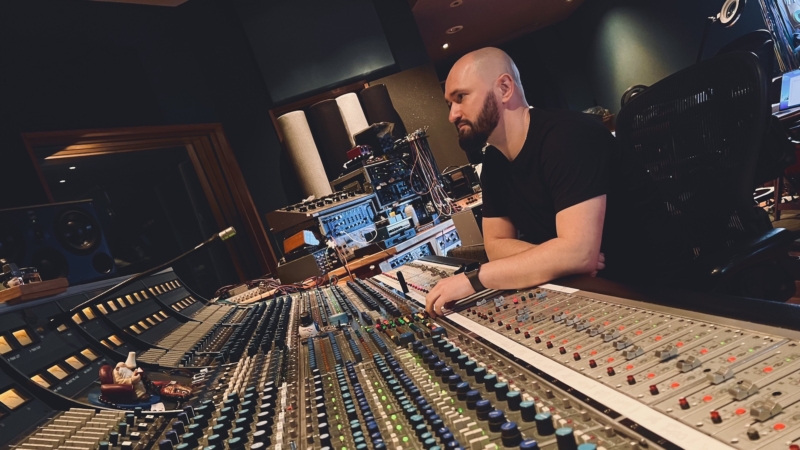
Siarhei Panamarou is a Belarusian-American producer, audio engineer, and voting member of the Recording Academy (GRAMMY) who has made a name for himself both in Europe and in the U.S., from winning the international Tank Factor competition by Wargaming to working in studios in New York and California. His strength is the ability to turn complex production into a clear, step-by-step process so that any track can be brought to a professional level. In this interview, we spoke with Siarhei about his experience and future plans.
We chat with the creator all about how he made his way from Minsk to the Recording Academy and how he became an important voice of the new music industry. The result is an interesting and informative read.
Do you remember the moment you first realized you wanted to create music rather than just play it?
I remember that moment very well. Back in music school, when I first started working with a synthesizer, I became interested in breaking down other people’s tracks into their components – how they were built inside. I wanted to understand why this particular kick works so well with this clap, where an unusual sound comes from and how to get it. Then I started recording separate parts onto a regular cassette and overdubbing on top – my father had a Technics tape deck that allowed overdubbing. It was an incredibly exciting feeling: you’re assembling music out of parts, and at some point you realize you can create something of your own.
That first synthesizer from your father seems to have been a turning point, what did those early experiments teach you about sound and creativity?
I will never forget my first synthesizer – a Yamaha PSR-520 with cartridges. I still sometimes look for it on eBay because I want to get that feeling back. It was quite limited in terms of functionality, so I constantly had to invent ways to solve different tasks. What I liked most was layering – you could turn on two sounds at once, and that already expanded creativity and let me shape a more “personal” sound.
You started out performing in Minsk nightclubs as a DJ. How did that scene influence your sense of rhythm and production style?
I got priceless experience in clubs – there’s no other place where you can really feel how a track works under real sound pressure. Talking to other DJs, watching how they play, what tools and techniques they use – all of that helped me develop and be more confident in trying different music genres.
What inspired you to move from live performance into studio production full-time?
I think it’s a natural stage for any DJ – at some point you transition into production. In my case it started when I began putting together a small studio at home, got really into professional gear, and gradually started making music for artists, not just for my own sets.
You’ve worked with artists like Gotye and The Basics, and even had a remix featured on Tiësto’s show. How did those connections come about?
I think that kind of “magic” almost always happens a bit randomly. We can want something for a long time, but what actually works is what we do sincerely and at our highest level – for me that’s music. The remix for the Belarusian artists Platon & Joolay made it into Tiësto’s radio show, I think, because at that time it really matched the current sound. And I met Wally (Gotye) and Kris already in the studio in New York – those were real professional connections that grew into collaboration.
What do you think defines your “signature” as a producer?
I can build pretty much any kind of sound, and I like making bright, rich mixes with a solid low end, while still keeping separation and clarity between all the elements.
You’ve trained over 500 students in Minsk and developed your own teaching methodology. What gaps did you see in traditional music education that you wanted to fill?
I always wanted to remove the barrier between “this is hard and unclear” and “I can do this.” It was important to me that someone who wants to enter the modern world of music production doesn’t spend years on academic solfeggio and theory, but immediately gets practical, working tools – how to build a track, how to mix it, how to achieve the right sound.
You describe your production style as a hybrid of digital and analog. What makes this balance so crucial to your sound?
Yes, today you can do the entire mix in the computer, and that’s totally fine. But as a producer and audio engineer with experience, I still hear the difference. In modern production you can skip hardware, but for me the final stages – especially mastering – work better when I print the track through real gear. And I really like running the sound through different preamps, because they give that density and character that a purely digital environment doesn’t always provide.
Your production work on Nai Katxa’s “Nai” album is up for Academy consideration, what drew you to that project?
I always try to take on projects that I genuinely like and where I feel the artist is “my” kind of artist. With Nai Katxa it was exactly like that: the performer fully trusted me with the production and the mix, which allowed me to shape the sound the way I heard it. Plus there was an unusual experience for me – working with a guest artist from the Amazon region, which added live ethnic colors and depth to the material.
What are you most excited about as you build your new full-cycle studio in the U.S.?
It’s not a fast process – it’s a very meticulous one, from choosing the space to selecting the equipment. But I really enjoy the process itself. And the fact that here in California there are basically unlimited opportunities for studio work and collaborations – that’s very inspiring too.
Looking ahead, what do you hope your legacy in music will be, as a producer, educator, and cultural connector?
I see myself first and foremost as a producer and engineer – creating music has taken up the biggest part of my life. My love for hardware constantly pushes me to look for new sounds. I think my legacy will be in creating strong, inspiring tracks and, at the same time, passing this experience on to the next generation of producers who also want to make professional music.
Connect with Siarhei Panamarou: INSTAGRAM